
Most buyers don't just want a lower price. They want to know how the bag they are paying for is actually made — and whether the factory behind it can deliver on time, at the right quality, without surprises.
At Chart Mate, we produce OEM and ODM bags across six production lines. Our daily output is around 3,000 bags, supported by roughly 150 workers on the floor. In this post, we walk you through the full production process, from the moment the fabric arrives to the moment the finished cartons leave the warehouse.
If you have ever asked, "What is the bag manufacturing process step by step?" — this is your answer.
Step 1: Cutting — Where the Shape Starts
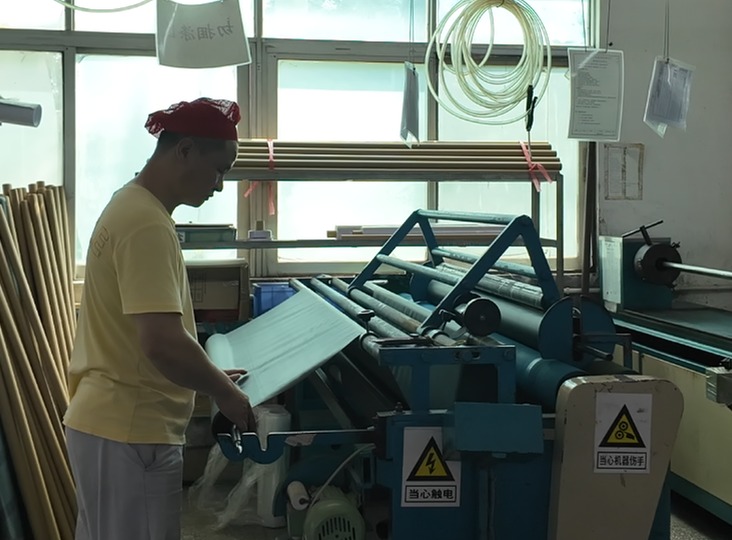
Every bag begins as a roll of fabric. Before a single stitch is sewn, the material goes through a cutting process that determines the shape, grain direction, and yield of the entire order.
What happens at the cutting table
- Fabric inspection: rolls are checked for color shading, defects, and width consistency before cutting.
- Pattern placement: patterns are laid out to minimize waste while keeping the grain straight.
- Cutting: depending on the material, we use manual cutting for small lots or machine-assisted cutting for larger volumes.
- Bundle sorting: cut pieces are bundled by size and color, labeled, and moved to the sewing floor.
This stage sounds simple, but it sets the ceiling for everything else. A mistake in cutting cannot be fixed later. At Chart Mate, our cutting team works ahead of the sewing lines so that material is always ready — one reason we can maintain a stable daily output.
Step 2: Sewing — Where Pieces Become a Bag
The sewing floor is the heart of the factory. This is where cut panels become panels with zippers, handles, linings, and structure.
How the sewing lines are organized
- Specialized stations: one worker may focus on main seams, another on zipper pockets, another on binding or piping.
- Flow production: the bag moves from station to station, with each operator adding one part of the construction.
- Inline checks: line leaders inspect stitches, alignment, and thread tension as the product moves.
Our six lines run at different speeds depending on the complexity of the style. A simple tote moves faster than a structured backpack with multiple pockets and padded panels. Across all styles, our combined sewing capacity sits at roughly 3,000 bags per day.
When clients visit on a video call, this is the stage they usually want to see most — because a sewing floor never lies. You can hear the machines, see the material, and judge the consistency with your own eyes.
Step 3: Quality Control — The Defect Does Not Leave
Quality control is not a single inspection at the end. At Chart Mate, it happens in two places: inline and final.
Inline QC on the sewing line
- Stitch length and consistency
- Thread color and tension
- Panel alignment and symmetry
- Zipper function and placement
Final QC before packing
- Overall shape and dimensions against the spec sheet
- Hardware function — zippers, sliders, buckles, rivets
- Thread trimming and cleanliness
- Color check against approved samples or Pantone references
Defective units are separated into a clearly marked reject area. We do not hide them. If a buyer asks for a factory walk, we show the reject corner along with the finished goods — because a factory that cannot show you its defects is a factory that may not be catching them.
We keep the full Pantone Solid Coated and Uncoated (PLUS Series) library on-site, so color matching is done against real physical chips, not screen colors or vague descriptions.
Step 4: Packing and Warehousing — Ready to Ship
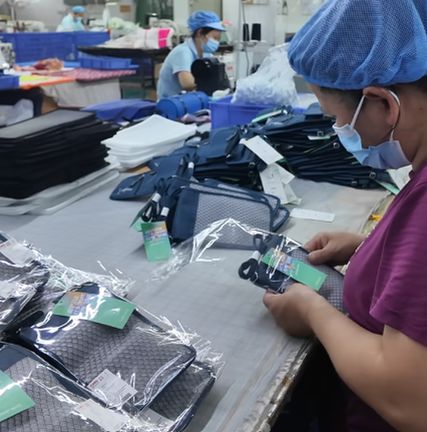
Once a bag passes QC, it moves to the packing area. This stage is easy to underestimate, but it protects the product from the factory floor to the customer's door.
Packing steps
- Pre-fold and stuffing: bags are shaped and stuffed to prevent creasing during transit.
- Individual protection: most styles are packed in OPP bags to keep dust and moisture out.
- Carton packing: units are packed according to the client's carton mark — usually a fixed quantity per inner carton and master carton.
- Final carton check: carton weight, dimensions, and labels are verified before stacking.
Finished cartons are moved to the warehouse staging area, organized by PO and destination, and held for final dispatch. For FOB orders, goods are then delivered to the port or forwarded to the buyer's logistics provider.
What the Numbers Look Like
Capacity numbers vary by style, but here is a realistic snapshot of how a typical order flows through Chart Mate.
| Stage | Typical Daily Capacity | What Determines Speed |
|---|---|---|
| Cutting | Enough to feed 3,000+ bags/day | Fabric layers, pattern complexity, number of pieces per bag |
| Sewing | ~3,000 bags/day | Number of lines, style complexity, worker allocation |
| Quality control | 100% inline + final check | Inspection points per style, defect rate |
| Packing | Matched to sewing output | Carton spec, labeling requirements, protection level |
With 150 workers spread across cutting, sewing, QC, packing, and warehouse support, the flow stays balanced. Bottlenecks are caught early because the production manager walks the floor every day.
Why Transparency in the Process Matters
When a buyer understands the production flow, two things improve: trust and planning.
Trust improves because the buyer can verify that the factory is real, organized, and consistent — not just a polished website. Planning improves because the buyer understands which changes are easy at which stage. A color change is still workable at cutting. A size change after sewing is expensive.
This is also why we encourage short, live video walkthroughs instead of pre-recorded factory tours. A live call lets a buyer ask to see the cutting table, then the sewing line, then the reject area, then the packing corner — without edits or script.
Quick Checklist: What to Ask on a Factory Video Call
Use this checklist on your next sourcing call to see how a supplier's process compares.
- ☐ Can you show me the cutting table and current fabric rolls?
- ☐ How many sewing lines do you run, and how many workers per line?
- ☐ Can I see an active order being sewn right now?
- ☐ Where do defective units go? Is the reject area visible?
- ☐ Do you have physical Pantone books for color matching?
- ☐ Can you show me the packing process and finished cartons?
- ☐ What is your daily capacity for a style similar to mine?
See the Process Yourself
If you are sourcing bags and want to see how a real factory moves from cutting to packing, we do live floor walks every week.
DM us "SAMPLE" on Instagram or TikTok — we will send you a sample of our work and schedule a 20-minute live factory walk so you can see each stage for yourself.
Or visit our factory and product catalog at chartmatebag.com.
Chart Mate — OEM/ODM bag factory. 150 workers. 3,000 bags a day. From cutting to packing, all under one roof.